HBase Row Key Design part 1

When one issues a get/scan query against HBase table via HTable or HTablePool, it will first lookup the -ROOT-, .META. tables to locate the region servers that host the data. This is the phase where most of the data irrelevant to our query got skipped. That’s why the row key design is so important when come to using HBase.

For example, one can use the following composite key to partition data based on siteId so that query to scan all users belong to a specific site can be done efficiently by specifying the startRow with prefix siteId.

Composite Key:
siteId|userId

-ROOT- and .META. lookup will locate all the region servers that contain the data for the specified siteId. Then, multiple get/scan RPC calls will be initialized against these region servers to retrieve the required results.

To be continued.

For example, when we call HTable get(List) method, it will call the processBatchCallback method in HConnectionImplementation. In this method, it finds out the region servers that host the data and then establish calls to these servers.


 public <R> void processBatchCallback(
        List<? extends Row> list,
        byte[] tableName,
        ExecutorService pool,
        Object[] results,
        Batch.Callback<R> callback)
    throws IOException, InterruptedException {
      // This belongs in HTable!!! Not in here.  St.Ack

      // results must be the same size as list
      if (results.length != list.size()) {
        throw new IllegalArgumentException(
            "argument results must be the same size as argument list");
      }
      if (list.isEmpty()) {
        return;
      }

      // Keep track of the most recent servers for any given item for better
      // exceptional reporting.  We keep HRegionLocation to save on parsing.
      // Later below when we use lastServers, we'll pull what we need from
      // lastServers.
      HRegionLocation [] lastServers = new HRegionLocation[results.length];
      List<Row> workingList = new ArrayList<Row>(list);
      boolean retry = true;
      // count that helps presize actions array
      int actionCount = 0;

      for (int tries = 0; tries < numRetries && retry; ++tries) {

        // sleep first, if this is a retry
        if (tries >= 1) {
          long sleepTime = ConnectionUtils.getPauseTime(this.pause, tries);
          LOG.debug("Retry " +tries+ ", sleep for " +sleepTime+ "ms!");
          Thread.sleep(sleepTime);
        }
        // step 1: break up into regionserver-sized chunks and build the data structs
        Map<HRegionLocation, MultiAction<R>> actionsByServer =
          new HashMap<HRegionLocation, MultiAction<R>>();
        for (int i = 0; i < workingList.size(); i++) {
          Row row = workingList.get(i);
          if (row != null) {
            HRegionLocation loc = locateRegion(tableName, row.getRow());
            byte[] regionName = loc.getRegionInfo().getRegionName();

            MultiAction<R> actions = actionsByServer.get(loc);
            if (actions == null) {
              actions = new MultiAction<R>();
              actionsByServer.put(loc, actions);
            }

            Action<R> action = new Action<R>(row, i);
            lastServers[i] = loc;
            actions.add(regionName, action);
          }
        }

        // step 2: make the requests

        Map<HRegionLocation, Future<MultiResponse>> futures =
            new HashMap<HRegionLocation, Future<MultiResponse>>(
                actionsByServer.size());

        for (Entry<HRegionLocation, MultiAction<R>> e: actionsByServer.entrySet()) {
          futures.put(e.getKey(), pool.submit(createCallable(e.getKey(), e.getValue(), tableName)));
        }

        // step 3: collect the failures and successes and prepare for retry

        for (Entry<HRegionLocation, Future<MultiResponse>> responsePerServer
             : futures.entrySet()) {
          HRegionLocation loc = responsePerServer.getKey();

          try {
            Future<MultiResponse> future = responsePerServer.getValue();
            MultiResponse resp = future.get();

            if (resp == null) {
              // Entire server failed
              LOG.debug("Failed all for server: " + loc.getHostnamePort() +
                ", removing from cache");
              continue;
            }

            for (Entry<byte[], List<Pair<Integer,Object>>> e : resp.getResults().entrySet()) {
              byte[] regionName = e.getKey();
              List<Pair<Integer, Object>> regionResults = e.getValue();
              for (Pair<Integer, Object> regionResult : regionResults) {
                if (regionResult == null) {
                  // if the first/only record is 'null' the entire region failed.
                  LOG.debug("Failures for region: " +
                      Bytes.toStringBinary(regionName) +
                      ", removing from cache");
                } else {
                  // Result might be an Exception, including DNRIOE
                  results[regionResult.getFirst()] = regionResult.getSecond();
                  if (callback != null && !(regionResult.getSecond() instanceof Throwable)) {
                    callback.update(e.getKey(),
                        list.get(regionResult.getFirst()).getRow(),
                        (R)regionResult.getSecond());
                  }
                }
              }
            }
          } catch (ExecutionException e) {
            LOG.warn("Failed all from " + loc, e);
          }
        }

        // step 4: identify failures and prep for a retry (if applicable).

        // Find failures (i.e. null Result), and add them to the workingList (in
        // order), so they can be retried.
        retry = false;
        workingList.clear();
        actionCount = 0;
        for (int i = 0; i < results.length; i++) {
          // if null (fail) or instanceof Throwable && not instanceof DNRIOE
          // then retry that row. else dont.
          if (results[i] == null ||
              (results[i] instanceof Throwable &&
                  !(results[i] instanceof DoNotRetryIOException))) {

            retry = true;
            actionCount++;
            Row row = list.get(i);
            workingList.add(row);
            deleteCachedLocation(tableName, row.getRow());
          } else {
            if (results[i] != null && results[i] instanceof Throwable) {
              actionCount++;
            }
            // add null to workingList, so the order remains consistent with the original list argument.
            workingList.add(null);
          }
        }
      }

      List<Throwable> exceptions = new ArrayList<Throwable>(actionCount);
      List<Row> actions = new ArrayList<Row>(actionCount);
      List<String> addresses = new ArrayList<String>(actionCount);

      for (int i = 0 ; i < results.length; i++) {
        if (results[i] == null || results[i] instanceof Throwable) {
          exceptions.add((Throwable)results[i]);
          actions.add(list.get(i));
          addresses.add(lastServers[i].getHostnamePort());
        }
      }

      if (!exceptions.isEmpty()) {
        throw new RetriesExhaustedWithDetailsException(exceptions,
            actions,
            addresses);
      }
    }
Apache Flume: Event

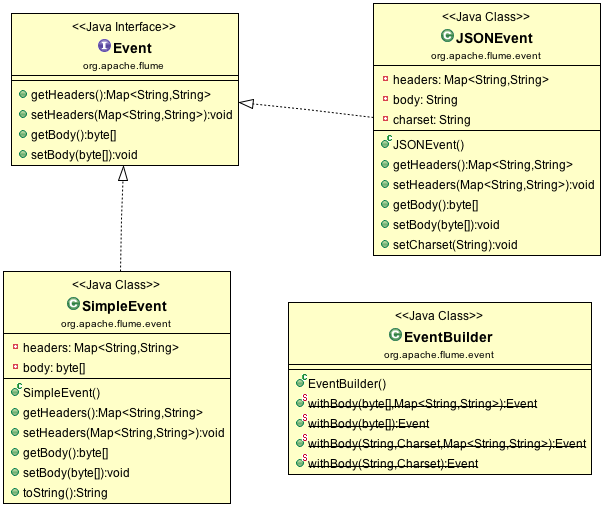
In Apache Flume, an event contains a header section and a payload. The header section is basically a map of properties whereas the payload is just a byte array. Let’s take a look at the Event interface class.


/*
 * Licensed to the Apache Software Foundation (ASF) under one
 * or more contributor license agreements.  See the NOTICE file
 * distributed with this work for additional information
 * regarding copyright ownership.  The ASF licenses this file
 * to you under the Apache License, Version 2.0 (the
 * "License"); you may not use this file except in compliance
 * with the License.  You may obtain a copy of the License at
 *
 * http://www.apache.org/licenses/LICENSE-2.0
 *
 * Unless required by applicable law or agreed to in writing,
 * software distributed under the License is distributed on an
 * "AS IS" BASIS, WITHOUT WARRANTIES OR CONDITIONS OF ANY
 * KIND, either express or implied.  See the License for the
 * specific language governing permissions and limitations
 * under the License.
 */

package org.apache.flume;

import java.util.Map;

/**
 * Basic representation of a data object in Flume.
 * Provides access to data as it flows through the system.
 */
public interface Event {

  /**
   * Returns a map of name-value pairs describing the data stored in the body.
   */
  public Map<String, String> getHeaders();

  /**
   * Set the event headers
   * @param headers Map of headers to replace the current headers.
   */
  public void setHeaders(Map<String, String> headers);

  /**
   * Returns the raw byte array of the data contained in this event.
   */
  public byte[] getBody();

  /**
   * Sets the raw byte array of the data contained in this event.
   * @param body The data.
   */
  public void setBody(byte[] body);

}

Both SimpleEvent and JSONEvent are the implementations of the Event interface. You could choose to use either one that fits your use cases. You could also use the EventBuilder class to create Event.

/*
 * Licensed to the Apache Software Foundation (ASF) under one
 * or more contributor license agreements.  See the NOTICE file
 * distributed with this work for additional information
 * regarding copyright ownership.  The ASF licenses this file
 * to you under the Apache License, Version 2.0 (the
 * "License"); you may not use this file except in compliance
 * with the License.  You may obtain a copy of the License at
 *
 * http://www.apache.org/licenses/LICENSE-2.0
 *
 * Unless required by applicable law or agreed to in writing,
 * software distributed under the License is distributed on an
 * "AS IS" BASIS, WITHOUT WARRANTIES OR CONDITIONS OF ANY
 * KIND, either express or implied.  See the License for the
 * specific language governing permissions and limitations
 * under the License.
 */

package org.apache.flume.event;

import java.util.HashMap;
import java.util.Map;

import org.apache.flume.Event;

public class SimpleEvent implements Event {

  private Map<String, String> headers;
  private byte[] body;

  public SimpleEvent() {
    headers = new HashMap<String, String>();
    body = new byte[0];
  }

  @Override
  public Map<String, String> getHeaders() {
    return headers;
  }

  @Override
  public void setHeaders(Map<String, String> headers) {
    this.headers = headers;
  }

  @Override
  public byte[] getBody() {
    return body;
  }

  @Override
  public void setBody(byte[] body) {
    if(body == null){
      body = new byte[0];
    }
    this.body = body;
  }

  @Override
  public String toString() {
    Integer bodyLen = null;
    if (body != null) bodyLen = body.length;
    return "[Event headers = " + headers + ", body.length = " + bodyLen + " ]";
  }

}

Events

One could create a RPCClient using the RPCClientFactory and start sending event to remote agent or AvroSource.
Look at the code example below as provided in http://flume.apache.org/FlumeDeveloperGuide.html


import org.apache.flume.Event;
import org.apache.flume.EventDeliveryException;
import org.apache.flume.api.RpcClient;
import org.apache.flume.api.RpcClientFactory;
import org.apache.flume.event.EventBuilder;
import java.nio.charset.Charset;

public class MyApp {
  public static void main(String[] args) {
    MyRpcClientFacade client = new MyRpcClientFacade();
    // Initialize client with the remote Flume agent's host and port
    client.init("host.example.org", 41414);

    // Send 10 events to the remote Flume agent. That agent should be
    // configured to listen with an AvroSource.
    String sampleData = "Hello Flume!";
    for (int i = 0; i < 10; i++) {
      client.sendDataToFlume(sampleData);
    }

    client.cleanUp();
  }
}

class MyRpcClientFacade {
  private RpcClient client;
  private String hostname;
  private int port;

  public void init(String hostname, int port) {
    // Setup the RPC connection
    this.hostname = hostname;
    this.port = port;
    this.client = RpcClientFactory.getDefaultInstance(hostname, port);
    // Use the following method to create a thrift client (instead of the above line):
    // this.client = RpcClientFactory.getThriftInstance(hostname, port);
  }

  public void sendDataToFlume(String data) {
    // Create a Flume Event object that encapsulates the sample data
    Event event = EventBuilder.withBody(data, Charset.forName("UTF-8"));

    // Send the event
    try {
      client.append(event);
    } catch (EventDeliveryException e) {
      // clean up and recreate the client
      client.close();
      client = null;
      client = RpcClientFactory.getDefaultInstance(hostname, port);
      // Use the following method to create a thrift client (instead of the above line):
      // this.client = RpcClientFactory.getThriftInstance(hostname, port);
    }
  }

  public void cleanUp() {
    // Close the RPC connection
    client.close();
  }

}

Factory Pattern

Factory pattern is used through Hadoop and other open source projects. I have collected some examples I found along the way.

org.apache.hadoop.io.WritableFactories


/**
 * Licensed to the Apache Software Foundation (ASF) under one
 * or more contributor license agreements.  See the NOTICE file
 * distributed with this work for additional information
 * regarding copyright ownership.  The ASF licenses this file
 * to you under the Apache License, Version 2.0 (the
 * "License"); you may not use this file except in compliance
 * with the License.  You may obtain a copy of the License at
 *
 *     http://www.apache.org/licenses/LICENSE-2.0
 *
 * Unless required by applicable law or agreed to in writing, software
 * distributed under the License is distributed on an "AS IS" BASIS,
 * WITHOUT WARRANTIES OR CONDITIONS OF ANY KIND, either express or implied.
 * See the License for the specific language governing permissions and
 * limitations under the License.
 */

package org.apache.hadoop.io;

import org.apache.hadoop.classification.InterfaceAudience;
import org.apache.hadoop.classification.InterfaceStability;
import org.apache.hadoop.conf.*;
import org.apache.hadoop.util.ReflectionUtils;
import java.util.HashMap;

/** Factories for non-public writables.  Defining a factory permits {@link
 * ObjectWritable} to be able to construct instances of non-public classes. */
@InterfaceAudience.Public
@InterfaceStability.Stable
public class WritableFactories {
  private static final HashMap<Class, WritableFactory> CLASS_TO_FACTORY =
    new HashMap<Class, WritableFactory>();

  private WritableFactories() {}                  // singleton

  /** Define a factory for a class. */
  public static synchronized void setFactory(Class c, WritableFactory factory) {
    CLASS_TO_FACTORY.put(c, factory);
  }

  /** Define a factory for a class. */
  public static synchronized WritableFactory getFactory(Class c) {
    return CLASS_TO_FACTORY.get(c);
  }

  /** Create a new instance of a class with a defined factory. */
  public static Writable newInstance(Class<? extends Writable> c, Configuration conf) {
    WritableFactory factory = WritableFactories.getFactory(c);
    if (factory != null) {
      Writable result = factory.newInstance();
      if (result instanceof Configurable) {
        ((Configurable) result).setConf(conf);
      }
      return result;
    } else {
      return ReflectionUtils.newInstance(c, conf);
    }
  }
  
  /** Create a new instance of a class with a defined factory. */
  public static Writable newInstance(Class<? extends Writable> c) {
    return newInstance(c, null);
  }

}

org.apache.hadoop.yarn.factories.impl.pb.RpcServerFactoryPBImpl


/**
* Licensed to the Apache Software Foundation (ASF) under one
* or more contributor license agreements.  See the NOTICE file
* distributed with this work for additional information
* regarding copyright ownership.  The ASF licenses this file
* to you under the Apache License, Version 2.0 (the
* "License"); you may not use this file except in compliance
* with the License.  You may obtain a copy of the License at
*
*     http://www.apache.org/licenses/LICENSE-2.0
*
* Unless required by applicable law or agreed to in writing, software
* distributed under the License is distributed on an "AS IS" BASIS,
* WITHOUT WARRANTIES OR CONDITIONS OF ANY KIND, either express or implied.
* See the License for the specific language governing permissions and
* limitations under the License.
*/

package org.apache.hadoop.yarn.factories.impl.pb;

import java.io.IOException;
import java.lang.reflect.Constructor;
import java.lang.reflect.InvocationTargetException;
import java.lang.reflect.Method;
import java.net.InetSocketAddress;
import java.util.concurrent.ConcurrentHashMap;
import java.util.concurrent.ConcurrentMap;

import org.apache.commons.logging.Log;
import org.apache.commons.logging.LogFactory;
import org.apache.hadoop.conf.Configuration;
import org.apache.hadoop.ipc.ProtobufRpcEngine;
import org.apache.hadoop.ipc.Server;
import org.apache.hadoop.ipc.RPC;
import org.apache.hadoop.security.token.SecretManager;
import org.apache.hadoop.security.token.TokenIdentifier;
import org.apache.hadoop.yarn.YarnException;
import org.apache.hadoop.yarn.factories.RpcServerFactory;

import com.google.protobuf.BlockingService;

public class RpcServerFactoryPBImpl implements RpcServerFactory {

  private static final Log LOG = LogFactory.getLog(RpcServerFactoryPBImpl.class);
  private static final String PROTO_GEN_PACKAGE_NAME = "org.apache.hadoop.yarn.proto";
  private static final String PROTO_GEN_CLASS_SUFFIX = "Service";
  private static final String PB_IMPL_PACKAGE_SUFFIX = "impl.pb.service";
  private static final String PB_IMPL_CLASS_SUFFIX = "PBServiceImpl";
  
  private static final RpcServerFactoryPBImpl self = new RpcServerFactoryPBImpl();

  private Configuration localConf = new Configuration();
  private ConcurrentMap<Class<?>, Constructor<?>> serviceCache = new ConcurrentHashMap<Class<?>, Constructor<?>>();
  private ConcurrentMap<Class<?>, Method> protoCache = new ConcurrentHashMap<Class<?>, Method>();
  
  public static RpcServerFactoryPBImpl get() {
    return RpcServerFactoryPBImpl.self;
  }
  

  private RpcServerFactoryPBImpl() {
  }
  
  public Server getServer(Class<?> protocol, Object instance,
      InetSocketAddress addr, Configuration conf,
      SecretManager<? extends TokenIdentifier> secretManager, int numHandlers)
      throws YarnException {
    return getServer(protocol, instance, addr, conf, secretManager, numHandlers,
        null);
  }
  
  @Override
  public Server getServer(Class<?> protocol, Object instance,
      InetSocketAddress addr, Configuration conf,
      SecretManager<? extends TokenIdentifier> secretManager, int numHandlers,
      String portRangeConfig)
      throws YarnException {
    
    Constructor<?> constructor = serviceCache.get(protocol);
    if (constructor == null) {
      Class<?> pbServiceImplClazz = null;
      try {
        pbServiceImplClazz = localConf
            .getClassByName(getPbServiceImplClassName(protocol));
      } catch (ClassNotFoundException e) {
        throw new YarnException("Failed to load class: ["
            + getPbServiceImplClassName(protocol) + "]", e);
      }
      try {
        constructor = pbServiceImplClazz.getConstructor(protocol);
        constructor.setAccessible(true);
        serviceCache.putIfAbsent(protocol, constructor);
      } catch (NoSuchMethodException e) {
        throw new YarnException("Could not find constructor with params: "
            + Long.TYPE + ", " + InetSocketAddress.class + ", "
            + Configuration.class, e);
      }
    }
    
    Object service = null;
    try {
      service = constructor.newInstance(instance);
    } catch (InvocationTargetException e) {
      throw new YarnException(e);
    } catch (IllegalAccessException e) {
      throw new YarnException(e);
    } catch (InstantiationException e) {
      throw new YarnException(e);
    }

    Class<?> pbProtocol = service.getClass().getInterfaces()[0];
    Method method = protoCache.get(protocol);
    if (method == null) {
      Class<?> protoClazz = null;
      try {
        protoClazz = localConf.getClassByName(getProtoClassName(protocol));
      } catch (ClassNotFoundException e) {
        throw new YarnException("Failed to load class: ["
            + getProtoClassName(protocol) + "]", e);
      }
      try {
        method = protoClazz.getMethod("newReflectiveBlockingService",
            pbProtocol.getInterfaces()[0]);
        method.setAccessible(true);
        protoCache.putIfAbsent(protocol, method);
      } catch (NoSuchMethodException e) {
        throw new YarnException(e);
      }
    }
    
    try {
      return createServer(pbProtocol, addr, conf, secretManager, numHandlers,
          (BlockingService)method.invoke(null, service), portRangeConfig);
    } catch (InvocationTargetException e) {
      throw new YarnException(e);
    } catch (IllegalAccessException e) {
      throw new YarnException(e);
    } catch (IOException e) {
      throw new YarnException(e);
    }
  }
  
  private String getProtoClassName(Class<?> clazz) {
    String srcClassName = getClassName(clazz);
    return PROTO_GEN_PACKAGE_NAME + "." + srcClassName + "$" + srcClassName + PROTO_GEN_CLASS_SUFFIX;  
  }
  
  private String getPbServiceImplClassName(Class<?> clazz) {
    String srcPackagePart = getPackageName(clazz);
    String srcClassName = getClassName(clazz);
    String destPackagePart = srcPackagePart + "." + PB_IMPL_PACKAGE_SUFFIX;
    String destClassPart = srcClassName + PB_IMPL_CLASS_SUFFIX;
    return destPackagePart + "." + destClassPart;
  }
  
  private String getClassName(Class<?> clazz) {
    String fqName = clazz.getName();
    return (fqName.substring(fqName.lastIndexOf(".") + 1, fqName.length()));
  }
  
  private String getPackageName(Class<?> clazz) {
    return clazz.getPackage().getName();
  }

  private Server createServer(Class<?> pbProtocol, InetSocketAddress addr, Configuration conf, 
      SecretManager<? extends TokenIdentifier> secretManager, int numHandlers, 
      BlockingService blockingService, String portRangeConfig) throws IOException {
    RPC.setProtocolEngine(conf, pbProtocol, ProtobufRpcEngine.class);
    RPC.Server server = RPC.getServer(pbProtocol, blockingService, 
        addr.getHostName(), addr.getPort(), numHandlers, false, conf, 
        secretManager, portRangeConfig);
    LOG.info("Adding protocol "+pbProtocol.getCanonicalName()+" to the server");
    server.addProtocol(RPC.RpcKind.RPC_PROTOCOL_BUFFER, pbProtocol, blockingService);
    return server;
  }
}


org.apache.flume.source.DefaultSourceFactory


/*
 * Licensed to the Apache Software Foundation (ASF) under one
 * or more contributor license agreements.  See the NOTICE file
 * distributed with this work for additional information
 * regarding copyright ownership.  The ASF licenses this file
 * to you under the Apache License, Version 2.0 (the
 * "License"); you may not use this file except in compliance
 * with the License.  You may obtain a copy of the License at
 *
 * http://www.apache.org/licenses/LICENSE-2.0
 *
 * Unless required by applicable law or agreed to in writing,
 * software distributed under the License is distributed on an
 * "AS IS" BASIS, WITHOUT WARRANTIES OR CONDITIONS OF ANY
 * KIND, either express or implied.  See the License for the
 * specific language governing permissions and limitations
 * under the License.
 */
package org.apache.flume.source;

import org.apache.flume.FlumeException;
import org.apache.flume.Source;
import org.apache.flume.SourceFactory;
import org.apache.flume.conf.source.SourceType;
import org.slf4j.Logger;
import org.slf4j.LoggerFactory;

import com.google.common.base.Preconditions;

public class DefaultSourceFactory implements SourceFactory {

  private static final Logger logger = LoggerFactory
      .getLogger(DefaultSourceFactory.class);

  @Override
  public Source create(String name, String type) throws FlumeException {
    Preconditions.checkNotNull(name, "name");
    Preconditions.checkNotNull(type, "type");
    logger.info("Creating instance of source {}, type {}", name, type);
    Class<? extends Source> sourceClass = getClass(type);
    try {
      Source source = sourceClass.newInstance();
      source.setName(name);
      return source;
    } catch (Exception ex) {
      throw new FlumeException("Unable to create source: " + name
          +", type: " + type + ", class: " + sourceClass.getName(), ex);
    }
  }
  @SuppressWarnings("unchecked")
  @Override
  public Class<? extends Source> getClass(String type)
  throws FlumeException {
    String sourceClassName = type;
    SourceType srcType = SourceType.OTHER;
    try {
      srcType = SourceType.valueOf(type.toUpperCase());
    } catch (IllegalArgumentException ex) {
      logger.debug("Source type {} is a custom type", type);
    }
    if (!srcType.equals(SourceType.OTHER)) {
      sourceClassName = srcType.getSourceClassName();
    }
    try {
      return (Class<? extends Source>) Class.forName(sourceClassName);
    } catch (Exception ex) {
      throw new FlumeException("Unable to load source type: " + type
          + ", class: " + sourceClassName, ex);
    }
  }
}

YARN RPC Part II

YarnRPC is the abstract base class that defines several abstract methods to return RPC client proxy and RPC server. HadoopYarnProtoRPC extends YarnRPC to provide concrete implementations to the defined abstract methods.


public abstract class YarnRPC {

 public abstract Object getProxy(Class protocol, InetSocketAddress addr,
      Configuration conf);

  public abstract void stopProxy(Object proxy, Configuration conf);

  public abstract Server getServer(Class protocol, Object instance,
      InetSocketAddress addr, Configuration conf,
      SecretManager<? extends TokenIdentifier> secretManager,
      int numHandlers, String portRangeConfig);

  public Server getServer(Class protocol, Object instance,
      InetSocketAddress addr, Configuration conf,
      SecretManager<? extends TokenIdentifier> secretManager,
      int numHandlers) {
    return getServer(protocol, instance, addr, conf, secretManager, numHandlers,
        null);
  }

}

Inside HadoopYarnProtoRPC, it uses RPCFactoryProvider which acts as a Singleton Factory to return different implementations of RPCServerFactory and RPCClientFactory interfaces.

Currently, we have RPCServerFactoryPBImpl which implements RPCServerFactory interface and RPCClientFactoryPBImpl which implements RPCClientFactory interface in YARN. These PB factories in turn allows us to inject different Protocol Buffer protocol implementations based on the protocol class in the creation of RPC server and client proxy by the underlying Hadoop RPC.

RpcClientAndServerFactory

Some examples of Protocol Buffer protocol implementations are

org.apache.hadoop.yarn.api.impl.pb.service
AMRMProtocolPBServiceImpl (will be injected if the protocol is AMRMProtocol)
ClientRMProtocolPBServiceImpl (will be injected if the protocol is ClientRMProtocol)

org.apache.hadoop.yarn.api.impl.pb.client
AMRMProtocolPBClientImpl
ClientRMProtocolClientImp


/**
* Licensed to the Apache Software Foundation (ASF) under one
* or more contributor license agreements.  See the NOTICE file
* distributed with this work for additional information
* regarding copyright ownership.  The ASF licenses this file
* to you under the Apache License, Version 2.0 (the
* "License"); you may not use this file except in compliance
* with the License.  You may obtain a copy of the License at
*
*     http://www.apache.org/licenses/LICENSE-2.0
*
* Unless required by applicable law or agreed to in writing, software
* distributed under the License is distributed on an "AS IS" BASIS,
* WITHOUT WARRANTIES OR CONDITIONS OF ANY KIND, either express or implied.
* See the License for the specific language governing permissions and
* limitations under the License.
*/

package org.apache.hadoop.yarn.factories.impl.pb;

import java.io.IOException;
import java.lang.reflect.Constructor;
import java.lang.reflect.InvocationTargetException;
import java.lang.reflect.Method;
import java.net.InetSocketAddress;
import java.util.concurrent.ConcurrentHashMap;
import java.util.concurrent.ConcurrentMap;

import org.apache.commons.logging.Log;
import org.apache.commons.logging.LogFactory;
import org.apache.hadoop.conf.Configuration;
import org.apache.hadoop.ipc.ProtobufRpcEngine;
import org.apache.hadoop.ipc.Server;
import org.apache.hadoop.ipc.RPC;
import org.apache.hadoop.security.token.SecretManager;
import org.apache.hadoop.security.token.TokenIdentifier;
import org.apache.hadoop.yarn.YarnException;
import org.apache.hadoop.yarn.factories.RpcServerFactory;

import com.google.protobuf.BlockingService;

public class RpcServerFactoryPBImpl implements RpcServerFactory {

  private static final Log LOG = LogFactory.getLog(RpcServerFactoryPBImpl.class);
  private static final String PROTO_GEN_PACKAGE_NAME = "org.apache.hadoop.yarn.proto";
  private static final String PROTO_GEN_CLASS_SUFFIX = "Service";
  private static final String PB_IMPL_PACKAGE_SUFFIX = "impl.pb.service";
  private static final String PB_IMPL_CLASS_SUFFIX = "PBServiceImpl";
  
  private static final RpcServerFactoryPBImpl self = new RpcServerFactoryPBImpl();

  private Configuration localConf = new Configuration();
  private ConcurrentMap<Class<?>, Constructor<?>> serviceCache = new ConcurrentHashMap<Class<?>, Constructor<?>>();
  private ConcurrentMap<Class<?>, Method> protoCache = new ConcurrentHashMap<Class<?>, Method>();
  
  public static RpcServerFactoryPBImpl get() {
    return RpcServerFactoryPBImpl.self;
  }
  

  private RpcServerFactoryPBImpl() {
  }
  
  public Server getServer(Class<?> protocol, Object instance,
      InetSocketAddress addr, Configuration conf,
      SecretManager<? extends TokenIdentifier> secretManager, int numHandlers)
      throws YarnException {
    return getServer(protocol, instance, addr, conf, secretManager, numHandlers,
        null);
  }
  
  @Override
  public Server getServer(Class<?> protocol, Object instance,
      InetSocketAddress addr, Configuration conf,
      SecretManager<? extends TokenIdentifier> secretManager, int numHandlers,
      String portRangeConfig)
      throws YarnException {
    
    Constructor<?> constructor = serviceCache.get(protocol);
    if (constructor == null) {
      Class<?> pbServiceImplClazz = null;
      try {
        pbServiceImplClazz = localConf
            .getClassByName(getPbServiceImplClassName(protocol));
      } catch (ClassNotFoundException e) {
        throw new YarnException("Failed to load class: ["
            + getPbServiceImplClassName(protocol) + "]", e);
      }
      try {
        constructor = pbServiceImplClazz.getConstructor(protocol);
        constructor.setAccessible(true);
        serviceCache.putIfAbsent(protocol, constructor);
      } catch (NoSuchMethodException e) {
        throw new YarnException("Could not find constructor with params: "
            + Long.TYPE + ", " + InetSocketAddress.class + ", "
            + Configuration.class, e);
      }
    }
    
    Object service = null;
    try {
      service = constructor.newInstance(instance);
    } catch (InvocationTargetException e) {
      throw new YarnException(e);
    } catch (IllegalAccessException e) {
      throw new YarnException(e);
    } catch (InstantiationException e) {
      throw new YarnException(e);
    }

    Class<?> pbProtocol = service.getClass().getInterfaces()[0];
    Method method = protoCache.get(protocol);
    if (method == null) {
      Class<?> protoClazz = null;
      try {
        protoClazz = localConf.getClassByName(getProtoClassName(protocol));
      } catch (ClassNotFoundException e) {
        throw new YarnException("Failed to load class: ["
            + getProtoClassName(protocol) + "]", e);
      }
      try {
        method = protoClazz.getMethod("newReflectiveBlockingService",
            pbProtocol.getInterfaces()[0]);
        method.setAccessible(true);
        protoCache.putIfAbsent(protocol, method);
      } catch (NoSuchMethodException e) {
        throw new YarnException(e);
      }
    }
    
    try {
      return createServer(pbProtocol, addr, conf, secretManager, numHandlers,
          (BlockingService)method.invoke(null, service), portRangeConfig);
    } catch (InvocationTargetException e) {
      throw new YarnException(e);
    } catch (IllegalAccessException e) {
      throw new YarnException(e);
    } catch (IOException e) {
      throw new YarnException(e);
    }
  }
  
  private String getProtoClassName(Class<?> clazz) {
    String srcClassName = getClassName(clazz);
    return PROTO_GEN_PACKAGE_NAME + "." + srcClassName + "$" + srcClassName + PROTO_GEN_CLASS_SUFFIX;  
  }
  
  private String getPbServiceImplClassName(Class<?> clazz) {
    String srcPackagePart = getPackageName(clazz);
    String srcClassName = getClassName(clazz);
    String destPackagePart = srcPackagePart + "." + PB_IMPL_PACKAGE_SUFFIX;
    String destClassPart = srcClassName + PB_IMPL_CLASS_SUFFIX;
    return destPackagePart + "." + destClassPart;
  }
  
  private String getClassName(Class<?> clazz) {
    String fqName = clazz.getName();
    return (fqName.substring(fqName.lastIndexOf(".") + 1, fqName.length()));
  }
  
  private String getPackageName(Class<?> clazz) {
    return clazz.getPackage().getName();
  }

  private Server createServer(Class<?> pbProtocol, InetSocketAddress addr, Configuration conf, 
      SecretManager<? extends TokenIdentifier> secretManager, int numHandlers, 
      BlockingService blockingService, String portRangeConfig) throws IOException {
    RPC.setProtocolEngine(conf, pbProtocol, ProtobufRpcEngine.class);
    RPC.Server server = RPC.getServer(pbProtocol, blockingService, 
        addr.getHostName(), addr.getPort(), numHandlers, false, conf, 
        secretManager, portRangeConfig);
    LOG.info("Adding protocol "+pbProtocol.getCanonicalName()+" to the server");
    server.addProtocol(RPC.RpcKind.RPC_PROTOCOL_BUFFER, pbProtocol, blockingService);
    return server;
  }
}

HBase HTable is not Thread Safe

HTable is the main class that one would use to interface with HBase table. It allows one to put/get/scan/delete operations on a HBase table. However,  it is not thread safe for read nor write.

HTable uses an arrayList writeBuffer to store put actions. As you can see in the doPut mehod, there is no synchronization. If multiple threads make calls to doPut methods, this would result in unexpected value results in your table.

private final ArrayList<Put> writeBuffer = new ArrayList<Put>();


private void doPut(Put put) throws IOException{
validatePut(put);
writeBuffer.add(put);
currentWriteBufferSize += put.heapSize();
if (currentWriteBufferSize > writeBufferSize) {
flushCommits();
}
}

Also, HTable has a setting called scannerCaching and is not synchronized in anyway. So the read operation using scan is not thread safe either.


 public int getScannerCaching() {
    return scannerCaching;
  }

 
  public void setScannerCaching(int scannerCaching) {
    this.scannerCaching = scannerCaching;
  }


 public ResultScanner getScanner(final Scan scan) throws IOException {
    if (scan.getCaching() <= 0) {
      scan.setCaching(getScannerCaching());
    }
    return new ClientScanner(getConfiguration(), scan, getTableName(),
        this.connection);
  }

Events in MapReduce V2

In the last post, we looked into the Yarn event structure. Today, we will look at different events introduced in MapReduce V2. These events are defined in the org.apache.hadoop.mapreduce.v2.app.job.event package.

AllEventTypes

Image

You will find different event types defined in the JobEventType, TaskEventType, TaskAttemptEventType enum classes.


/**
 * Event types handled by Job.
 */
public enum JobEventType {

  //Producer:Client
  JOB_KILL,

  //Producer:MRAppMaster
  JOB_INIT,
  JOB_START,

  //Producer:Task
  JOB_TASK_COMPLETED,
  JOB_MAP_TASK_RESCHEDULED,
  JOB_TASK_ATTEMPT_COMPLETED,

  //Producer:CommitterEventHandler
  JOB_SETUP_COMPLETED,
  JOB_SETUP_FAILED,
  JOB_COMMIT_COMPLETED,
  JOB_COMMIT_FAILED,
  JOB_ABORT_COMPLETED,

  //Producer:Job
  JOB_COMPLETED,

  //Producer:Any component
  JOB_DIAGNOSTIC_UPDATE,
  INTERNAL_ERROR,
  JOB_COUNTER_UPDATE,

  //Producer:TaskAttemptListener
  JOB_TASK_ATTEMPT_FETCH_FAILURE,

  //Producer:RMContainerAllocator
  JOB_UPDATED_NODES

}

Hadoop YARN Event Bus

Hadoop YARN uses an event bus to centralize the dispatching of various events and handling of events by different declared event handlers. This means less plumbing codes to write and maintain. Also, it decouples the event handling logics from different interacting components into one place.

AsyncDispatcher is such event bus. It uses a linkedBlockingQueue to queue up incoming events. Also, it has an internal thread, called eventHandlingThread to listen on the above queue and take event out for processing by calling the dispatch(event) method. In this method, it basically retrieves the corresponding event handler to handle the event accordingly.

AsyncDispatcherUML

/**
 * Licensed to the Apache Software Foundation (ASF) under one
 * or more contributor license agreements.  See the NOTICE file
 * distributed with this work for additional information
 * regarding copyright ownership.  The ASF licenses this file
 * to you under the Apache License, Version 2.0 (the
 * "License"); you may not use this file except in compliance
 * with the License.  You may obtain a copy of the License at
 *
 *     http://www.apache.org/licenses/LICENSE-2.0
 *
 * Unless required by applicable law or agreed to in writing, software
 * distributed under the License is distributed on an "AS IS" BASIS,
 * WITHOUT WARRANTIES OR CONDITIONS OF ANY KIND, either express or implied.
 * See the License for the specific language governing permissions and
 * limitations under the License.
 */

package org.apache.hadoop.yarn.event;

import java.util.ArrayList;
import java.util.HashMap;
import java.util.List;
import java.util.Map;
import java.util.concurrent.BlockingQueue;
import java.util.concurrent.LinkedBlockingQueue;

import org.apache.commons.logging.Log;
import org.apache.commons.logging.LogFactory;
import org.apache.hadoop.conf.Configuration;
import org.apache.hadoop.util.ShutdownHookManager;
import org.apache.hadoop.yarn.YarnException;
import org.apache.hadoop.yarn.service.AbstractService;

/**
 * Dispatches events in a separate thread. Currently only single thread does
 * that. Potentially there could be multiple channels for each event type
 * class and a thread pool can be used to dispatch the events.
 */
@SuppressWarnings("rawtypes")
public class AsyncDispatcher extends AbstractService implements Dispatcher {

  private static final Log LOG = LogFactory.getLog(AsyncDispatcher.class);

  private final BlockingQueue eventQueue;
  private volatile boolean stopped = false;

  private Thread eventHandlingThread;
  protected final Map<Class<? extends Enum>, EventHandler> eventDispatchers;
  private boolean exitOnDispatchException;

  public AsyncDispatcher() {
    this(new LinkedBlockingQueue());
  }

  public AsyncDispatcher(BlockingQueue eventQueue) {
    super("Dispatcher");
    this.eventQueue = eventQueue;
    this.eventDispatchers = new HashMap<Class<? extends Enum>, EventHandler>();
  }

  Runnable createThread() {
    return new Runnable() {
      @Override
      public void run() {
        while (!stopped && !Thread.currentThread().isInterrupted()) {
          Event event;
          try {
            event = eventQueue.take();
          } catch(InterruptedException ie) {
            if (!stopped) {
              LOG.warn("AsyncDispatcher thread interrupted", ie);
            }
            return;
          }
          if (event != null) {
            dispatch(event);
          }
        }
      }
    };
  }

  @Override
  public synchronized void init(Configuration conf) {
    this.exitOnDispatchException =
        conf.getBoolean(Dispatcher.DISPATCHER_EXIT_ON_ERROR_KEY,
          Dispatcher.DEFAULT_DISPATCHER_EXIT_ON_ERROR);
    super.init(conf);
  }

  @Override
  public void start() {
    //start all the components
    super.start();
    eventHandlingThread = new Thread(createThread());
    eventHandlingThread.setName("AsyncDispatcher event handler");
    eventHandlingThread.start();
  }

  @Override
  public void stop() {
    stopped = true;
    if (eventHandlingThread != null) {
      eventHandlingThread.interrupt();
      try {
        eventHandlingThread.join();
      } catch (InterruptedException ie) {
        LOG.warn("Interrupted Exception while stopping", ie);
      }
    }

    // stop all the components
    super.stop();
  }

  @SuppressWarnings("unchecked")
  protected void dispatch(Event event) {
    //all events go thru this loop
    if (LOG.isDebugEnabled()) {
      LOG.debug("Dispatching the event " + event.getClass().getName() + "."
          + event.toString());
    }

    Class<? extends Enum> type = event.getType().getDeclaringClass();

    try{
      EventHandler handler = eventDispatchers.get(type);
      if(handler != null) {
        handler.handle(event);
      } else {
        throw new Exception("No handler for registered for " + type);
      }
    }
    catch (Throwable t) {
      //TODO Maybe log the state of the queue
      LOG.fatal("Error in dispatcher thread", t);
      if (exitOnDispatchException
          && (ShutdownHookManager.get().isShutdownInProgress()) == false) {
        LOG.info("Exiting, bbye..");
        System.exit(-1);
      }
    }
  }

  @SuppressWarnings("unchecked")
  @Override
  public void register(Class<? extends Enum> eventType,
      EventHandler handler) {
    /* check to see if we have a listener registered */
    EventHandler registeredHandler = (EventHandler)
    eventDispatchers.get(eventType);
    LOG.info("Registering " + eventType + " for " + handler.getClass());
    if (registeredHandler == null) {
      eventDispatchers.put(eventType, handler);
    } else if (!(registeredHandler instanceof MultiListenerHandler)){
      /* for multiple listeners of an event add the multiple listener handler */
      MultiListenerHandler multiHandler = new MultiListenerHandler();
      multiHandler.addHandler(registeredHandler);
      multiHandler.addHandler(handler);
      eventDispatchers.put(eventType, multiHandler);
    } else {
      /* already a multilistener, just add to it */
      MultiListenerHandler multiHandler
      = (MultiListenerHandler) registeredHandler;
      multiHandler.addHandler(handler);
    }
  }

  @Override
  public EventHandler getEventHandler() {
    return new GenericEventHandler();
  }

  class GenericEventHandler implements EventHandler {
    public void handle(Event event) {
      /* all this method does is enqueue all the events onto the queue */
      int qSize = eventQueue.size();
      if (qSize !=0 && qSize %1000 == 0) {
        LOG.info("Size of event-queue is " + qSize);
      }
      int remCapacity = eventQueue.remainingCapacity();
      if (remCapacity < 1000) {
        LOG.warn("Very low remaining capacity in the event-queue: "
            + remCapacity);
      }
      try {
        eventQueue.put(event);
      } catch (InterruptedException e) {
        if (!stopped) {
          LOG.warn("AsyncDispatcher thread interrupted", e);
        }
        throw new YarnException(e);
      }
    };
  }

  /**
   * Multiplexing an event. Sending it to different handlers that
   * are interested in the event.
   * @param  the type of event these multiple handlers are interested in.
   */
  static class MultiListenerHandler implements EventHandler {
    List<EventHandler> listofHandlers;

    public MultiListenerHandler() {
      listofHandlers = new ArrayList<EventHandler>();
    }

    @Override
    public void handle(Event event) {
      for (EventHandler handler: listofHandlers) {
        handler.handle(event);
      }
    }

    void addHandler(EventHandler handler) {
      listofHandlers.add(handler);
    }

  }
}

Hadoop YARN RPC (part I)

I have spent some time digging into YARN RPC source codes. Personally, I like the use of Factory pattern to inject different RPC proxy client protocol and server implementations to the framework. It looks way cleaner and better compared to the older versions of Hadoop.

For example: RpcServerFactoryPBImpl is the implementation of RpcServerFactory interface to create Protobuf RPC Server. Basically, it delegates the creation using the standard Hadoop RPC class.

Look at the following snippet in RpcServerFactoryPBImpl,

private Server createServer(Class<?> pbProtocol, InetSocketAddress addr, Configuration conf, 
      SecretManager<? extends TokenIdentifier> secretManager, int numHandlers, 
      BlockingService blockingService, String portRangeConfig) throws IOException {
    RPC.setProtocolEngine(conf, pbProtocol, ProtobufRpcEngine.class);
    RPC.Server server = RPC.getServer(pbProtocol, blockingService, 
        addr.getHostName(), addr.getPort(), numHandlers, false, conf, 
        secretManager, portRangeConfig);
    LOG.info("Adding protocol "+pbProtocol.getCanonicalName()+" to the server");
    server.addProtocol(RPC.RpcKind.RPC_PROTOCOL_BUFFER, pbProtocol, blockingService);
    return server;
  }

We could create a new type of RPC Server Factory called RpcServerFactoryMyOwnImpl that implements the above createServer method which would return our own RPC Server.

In YARN framework, HadoopYarnProtoRPC is the class uses these factories.
Basically, it calls RpcFactoryProvider.getServerFactory(conf) to get the right RpcServerFactory implementation.


public class HadoopYarnProtoRPC extends YarnRPC {

  private static final Log LOG = LogFactory.getLog(HadoopYarnProtoRPC.class);

  @Override
  public Object getProxy(Class protocol, InetSocketAddress addr,
      Configuration conf) {
    LOG.debug("Creating a HadoopYarnProtoRpc proxy for protocol " + protocol);
    return RpcFactoryProvider.getClientFactory(conf).getClient(protocol, 1,
        addr, conf);
  }

  @Override
  public void stopProxy(Object proxy, Configuration conf) {
    RpcFactoryProvider.getClientFactory(conf).stopClient(proxy);
  }

  @Override
  public Server getServer(Class protocol, Object instance,
      InetSocketAddress addr, Configuration conf,
      SecretManager<? extends TokenIdentifier> secretManager,
      int numHandlers, String portRangeConfig) {
    LOG.debug("Creating a HadoopYarnProtoRpc server for protocol " + protocol + 
        " with " + numHandlers + " handlers");
    
    return RpcFactoryProvider.getServerFactory(conf).getServer(protocol, 
        instance, addr, conf, secretManager, numHandlers, portRangeConfig);

  }

}

To be continued…